
Introduction
The question ‘What is AI automation?’ has become increasingly common as businesses recognize the transformative potential of intelligent systems. In today’s digital landscape, understanding how to use AI to automate tasks is not just a competitive advantage—it is becoming essential for operational efficiency. Whether you are wondering about the fundamentals or exploring how to automate tasks with AI at an enterprise level, this guide covers everything you need to know.
AI automation represents the convergence of artificial intelligence and process automation, creating systems that can learn, adapt, and execute complex workflows with minimal human intervention. But is AI automation the same as traditional automation? And how does this relate to emerging technologies like robotic process automation and agentic AI? Let us explore these questions in depth.
What Is AI Automation? Understanding the Basics
Defining AI Automation
At its core, AI automation refers to the use of artificial intelligence technologies—such as machine learning, natural language processing, and computer vision—to automate business processes, workflows, and tasks. Unlike traditional automation, which follows pre-programmed rules and scripts, AI automation systems can learn from data, recognize patterns, and make intelligent decisions without explicit programming for every scenario.
The distinction is crucial. Traditional automation is like a machine that performs the exact same task in the exact same way every single time. AI automation, by contrast, can adapt to variations, handle exceptions, and improve its performance over time through machine learning algorithms.
Key characteristics of AI automation include:
- Intelligent decision-making: Systems that analyze information and choose the best course of action
- Continuous learning: Algorithms that improve as they process more data
- Exception handling: Ability to manage unexpected scenarios without human intervention
- Contextual understanding: Recognition of nuances in data and business processes
- Scalability: Capacity to handle increasing volumes of work without proportional increases in resources
Is AI Automation Different from Regular Automation?
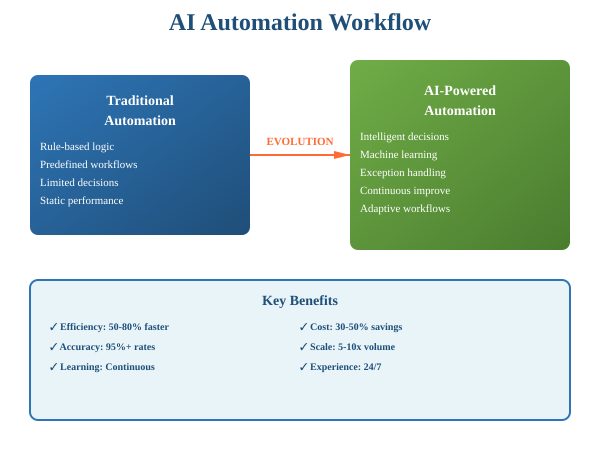
The fundamental difference lies in complexity and adaptability. Regular automation works through fixed rule-based logic, predetermined workflow paths, limited decision-making capabilities, and static performance metrics. AI-driven automation operates through machine learning models that improve with experience, dynamic workflow adjustment based on real-time data, complex decision-making based on multiple variables, and continuously improving accuracy and efficiency.
Consider a customer service scenario. Traditional automation might route an email to a specific department based on keywords. AI automation would understand the customer intent, prioritize the issue based on sentiment analysis, route it to the most appropriate specialist based on their expertise and current workload, and even draft a response that learns from previous successful interactions.
Visual Overview of AI Automation
The diagram below illustrates the key differences between traditional and AI-powered automation:
How to Use AI to Automate Tasks: Practical Applications
Understanding Common Use Cases
Learning how to automate tasks with AI begins with identifying which processes benefit most from intelligent automation. The best candidates for AI automation typically involve:
- Data-intensive processes requiring analysis and interpretation—such as invoice processing, data entry validation, and report generation
- Repetitive cognitive tasks like email categorization, document summarization, and content moderation
- Decision-making processes involving multiple variables—including loan approvals, customer segmentation, and resource allocation
- Customer-facing operations that benefit from personalization—such as chatbots, recommendation engines, and personalized marketing
Step-by-Step Implementation Strategy
1. Process Assessment and Selection
Begin by auditing your current workflows. Which processes consume the most time? Which involve repetitive decision-making? Which have high error rates? Which would benefit from faster execution or personalization? The most successful AI automation implementations start with processes that are well-defined with clear inputs and outputs, data-rich with quality training data, high-volume to justify investment, and impactful for improving customer satisfaction or operational efficiency.
2. Data Preparation and Quality Assurance
AI systems are only as good as the data they are trained on. Ensure your data is complete (all necessary information captured), accurate (reflects reality), consistent (standardized across systems), and representative (reflects real-world scenarios). Many organizations underestimate this phase, with data preparation typically consuming 60-80% of an AI implementation project timeline.
3. Model Selection and Training
Different AI automation scenarios require different approaches. You might use classification models for categorizing tasks, regression models for predicting outcomes, natural language processing for understanding language, computer vision for image analysis, or reinforcement learning for optimization.
4. Integration and Testing
Before full deployment, test your AI automation in a controlled environment. Create pilot programs that process real data, allow comparison between AI and human decisions, identify edge cases for refinement, and measure accuracy, speed, and cost improvements.
5. Monitoring and Continuous Improvement
Launch your AI automation knowing that ongoing monitoring is critical. Track accuracy rates compared to baseline performance, processing time and cost savings, error patterns and anomalies, user satisfaction and adoption metrics, and drift in model performance over time.
Is Robotic Process Automation AI? Clarifying the Terminology
The Relationship Between RPA and AI
A common question in automation discussions: Is robotic process automation AI? The answer is nuanced. RPA uses software robots that automate structured, rule-based tasks through script-based workflows, user interface automation, rule engines, and template matching. RPA is not inherently AI, but increasingly, RPA platforms incorporate AI capabilities, creating what is called Intelligent Process Automation (IPA).
Agentic AI: The Next Evolution in Automation
How Does Agentic AI Differ from Traditional Automation?
A new paradigm in automation is emerging: agentic AI. Understanding how agentic AI differs from traditional automation is crucial for forward-thinking organizations. Traditional automation operates reactively—you define a process, train the system, deploy it, and it executes. Agentic AI operates proactively and autonomously.
Key differences include:
- Goal-oriented behavior: Instead of executing predefined steps, systems work toward defined goals
- Autonomous decision-making: Systems can decide when to take action and revise approaches
- Multi-step reasoning: Breaking complex problems into sub-tasks and adjusting based on outcomes
- Tool utilization: Identifying and using appropriate tools to accomplish objectives
- Learning and adaptation: Improving not just at pattern recognition but at strategy selection
What AI-Driven Platforms Can Automate Startup Discovery?
Advanced AI-driven platforms automate the startup discovery process by aggregating data from funding databases, analyzing pitch decks using computer vision, understanding business models through natural language processing, analyzing technology stacks, tracking financial indicators, and identifying network connections. These platforms significantly reduce discovery time from months to days while accessing a much broader universe of opportunities.
How to Choose an AI Automation Platform Based on Pricing
Understanding AI Automation Platform Pricing Models
Most AI automation platforms employ several pricing approaches. Subscription-based pricing works best for organizations with predictable needs, typically costing $500-$10,000+ monthly. Transaction-based pricing ($0.01-$5 per transaction) suits variable workloads. Hybrid models combine base fees with overages. Perpetual licensing ($20,000-$500,000+) works for on-premises deployments.
Strategic Approach to Platform Selection
- Define your automation scope: Number of processes, transaction volume, storage needs, integration complexity
- Calculate total cost of ownership: Include implementation, migration, training, staff time, and support
- Compare pricing transparently: Create projections for 12, 24, and 36 months
- Evaluate hidden costs: Overages, advanced features, custom integration, premium support
- Assess value beyond price: Ease of use, out-of-the-box capabilities, scalability, support quality, security
Conclusion: The Automation Future is Here
The evolution from traditional automation to AI-powered systems to autonomous agentic AI represents a fundamental shift in how businesses operate. Understanding what is AI automation, how to use it effectively, and how to choose the right platforms will determine competitive success in the coming years.
Whether you are evaluating whether AI automation is appropriate for your processes, comparing how agentic AI differs from traditional automation, or determining how to choose an AI automation platform based on pricing, the framework presented here provides a practical roadmap.
Start small with high-impact, well-defined processes. Build internal expertise. Measure results rigorously. Scale gradually. And continuously assess how emerging technologies might unlock new possibilities in your operations. The organizations that master AI automation in the next 24-36 months will establish competitive advantages that take years for others to match.
Frequently Asked Questions
Get answers to common questions about AI automation, implementation, and platform selection:
Q1: Is AI automation the same as traditional automation?
No. Traditional automation uses fixed rules and predefined workflows, while AI automation adapts using machine learning. Traditional automation handles the same task identically every time. AI automation learns from data, handles variations, and improves performance over time.
Q2: What is the difference between RPA and AI automation?
RPA (Robotic Process Automation) uses software robots to automate rule-based tasks through user interface automation. AI automation adds machine learning, natural language processing, and computer vision to handle complex, unstructured data and make intelligent decisions.
Q3: Is robotic process automation AI?
Traditional RPA is not inherently AI—it is rule-based automation. However, modern RPA platforms increasingly incorporate AI capabilities, creating Intelligent Process Automation (IPA) that combines the structure of RPA with AI learning abilities.
Q4: How does agentic AI differ from traditional automation?
Traditional automation executes predefined processes. Agentic AI works toward defined goals, autonomously choosing actions and sequences, revising approaches based on results, and utilizing available tools intelligently. It is proactive rather than reactive.
Q5: What are the best processes to automate with AI?
Good candidates include: data-intensive processes (invoice processing, data entry), repetitive cognitive tasks (email categorization, document summarization), decision-making processes (loan approvals, customer segmentation), and customer-facing operations (chatbots, personalization).
Q6: How much does AI automation cost?
Pricing varies: subscription-based ($500-$10,000+ monthly), transaction-based ($0.01-$5 per transaction), hybrid models (base fee plus overages), or perpetual licensing ($20,000-$500,000+). Total cost of ownership includes implementation, integration, training, and support.
Q7: How long does AI automation implementation take?
Most implementations take 3-12 months from planning to full deployment. Timelines vary based on process complexity, data quality, integration requirements, and change management needs. Data preparation alone typically takes 60-80% of project time.
Q8: What ROI can we expect from AI automation?
Organizations typically see: 50-80% faster processing, 30-50% cost reduction, 95%+ accuracy rates, 5-10x capacity increases, and improved customer experience. However, success requires proper implementation, realistic expectations, and continuous monitoring.
Q9: What are the key challenges in implementing AI automation?
Main challenges include: data quality issues, insufficient training data, change management resistance, integration complexity, regulatory compliance concerns, skills gaps, and unrealistic ROI expectations. Success requires proper planning and organizational commitment.
Q10: What AI-driven platforms can automate startup discovery?
Advanced platforms aggregate data from funding databases, job postings, press releases, social media, and technology indicators. They analyze pitch decks, funding patterns, technology stacks, and founder backgrounds to identify promising startups for investment or partnership.
Q11: How do we choose an AI automation platform based on pricing?
Compare total cost of ownership over 12, 24, and 36 months. Consider: number of processes to automate, monthly transaction volume, implementation costs, integration complexity, support requirements, and scalability. Use actual requirements, not guesswork, for accurate comparisons.
Q12: Is AI automation suitable for our business?
AI automation works best for organizations with: high-volume, repetitive processes; quality data; ability to invest in implementation; readiness for change management; and clear metrics for success. Small improvements in small processes are not worth the investment.